



Structural Components of
Gothic Churches and Cathedrals :
 Aisle : Passageways of a church or cathedral, separated from the Nave by rows of pillars; generally running along the north and south sides. Ambulatory : A continuous isle which wraps a circular structure or an apse at its base. Designed for use in Processions. Apse : A vaulted element in a church or cathedral which serves to terminate a semicircular Aisle or Chapel. The Apse, generally domed, will often form the Altar. The term is derived from the Medieval Latin: absis or apsis.
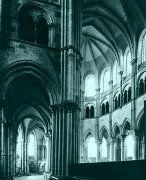 Basilica : A term sometimes used in reference to a cathedral for ceremonial reasons, although traditionally denoting an earlier form of structure.
Image at right : Basilica Saint Madeleine, Vézelay, France; choir viewed from transept.
The Basilica is the archetype of succeeding cathedral forms, the most famous of which is the early Saint Peter's in Rome. A Basilica consists of a Nave bordered along its side by Aisles with a Clerestory and an Apse.
Chancel : Altar space reserved for the clergy or choir, bordered by railings. Chantry chapel : A sub-chapel set aside for chanting of masses, often sponsored through an endowment. Prayers in the Chantry chapel are generally dedicated to the donor. Chapter house : The administrative center or Bishop's office, attached to a cathedral, traditionally organized for the overseeing of a cathedral's construction and maintenance. Chevet : The extreme east of a cathedral when Chapels encircle an Apse and an Ambulatory. Choir : The area located between the Sanctuary and the Nave. By definition: the place where the psalms are sung. Loosely used to define the whole East end of a cathedral, and as a synonym for Chancel. Traditionally inaccessible to the public, reserved for the clergy or members of the choir. Clerestory : The upper area of the Nave, Transepts and Choir. The raised passage, above the Aisles, often windowed. Crossing : The central space of a church or cathedral. The intersection of the Nave, Transepts and Chancel.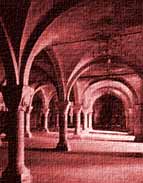 Crypt : The rooms below the cathedral designated as burial chambers.
Image at right : The Romanesque crypt of Canterbury cathedral, England.
Cupola : The turret which serves as the crown to the dome or roof of a structure. Garth : The garden or court within a cloister, usually attached to or near a cathedral. Hall church : A structure which does not contain a Clerestory or Triforium, thus the Aisles and Nave will be approximately the same height. Narthex : A ceilinged porch or vestibule situated west of the Nave and Aisles. (Sometimes referred to as a Galilee.)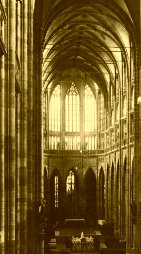 Nave : The central area of the western branch of a cathedral, bordered by Aisles. The center of a church or cathedral, intended for seating of parishioners.
Image at right : The nave interior of Saint Vitus cathedral, Prague, Czech Republic.
Oratory : A small chapel or private room set aside for individual prayer. Parvis : An area situated before a church or cathedral, in some instances enclosed. Porch : The reception space situated at the entrance to a church or cathedral. Presbytery (Sanctuary) : The area east of the Choir which contains or features the High Altar. The area of a church or cathedral reserved for the clergy. Retrochoir : The space situated directly to the rear of the altar in a church or cathedral. Sacristy : The secure storing chamber for holy relics and sacred vestments.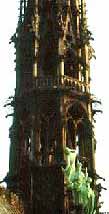 Spire : A tapering, often elegant, structure set atop a tower. In certain instances, the tower itself has been designed as a spire. On churches, smaller scale spires are often referred to as Steeples.
Image at right : The spire over the crossing of the transepts at Notre Dame de Paris; a 19th century addition designed and overseen by Eugène Emmanuel Viollet-le-Duc.
Transepts : The north and south projecting extensions of a Cruciform style church or cathedral, crossing at right angles to the greater length. Triforium : A walled passageway opening with arcades which run along and above the Nave, below the Clerestory.“The ground-plan of a typical Auvergnese church was developed from the early Christian basilica plan. Transept-arms and a choir give it the cruciform shape; the long nave is flanked by aisles; the primitive projecting narthex is replaced by a vestibule which is included behind the main façade; and the apse is encircled by chapels. This was the plan characteristic of those Northern Romanesque styles from which the Gothic styles were to spring. But in Auvergne the structure raised upon this plan was distinctively Southern in idea, and at the same time distinctively local in treatment.
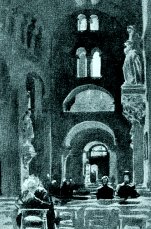
The aisles of Notre Dame du Port like those in Poitou and Provence, are much taller than the old basilican aisles which, with great triforia and clearstories above them, were retained in Northern Romanesque and in Gothic art. Once again this increase in altitude is explained by the desire for high-palced lateral vaults as buttresses for the long barrel-vault of the nave. But the Auvergnese aisle is not so very lofty as are those of Poitou and Provence, and its service as a buttress is performed in a different way.
In Poitou and Provence the aisle-vault is the half of a barrel-vault,—continuous, and in section the quarter of a circle,—and it meets the nave-wall at so high a point that in Provence this wall gives space only for a range of very small clearstory windows, and in Poitou for no openings at all. But in Auvergne the less lofty aisle is covered by a series of rectangular intersecting vaults. These support a triforium gallery. The ceiling of this gallery is not of wood, as are those of the triforia of Romanesque churches in the North, but is a second series of intersecting vaults. Above these is thrown the actual buttressing vault, which like the aisle-vault proper in Poitou and Provence, is half of a barrell-vault. Thus that safe construction of stone ceilings above the broad nave, which in all Southern provinces was achieved much earlier than at the North, was most elaborately and scientifically compassed in Auvergne, and also most beautifully.”
—Mrs. Schuyler Van Rensselaer,The Churches of Auvergne, The Century Magazine, 1899
Image : The West end of Notre Dame du Port by Clermont Ferrand.
“... if from the examination of the general features we proceed to the details of the building, every one who understands construction will be amazed to see what numberless precautions are resorted to in the execution,—how the prudence of the practical builder is combined with the daring of the artist full of power and inventive imagination; while in examining the mouldings and the sculpture we remark the use of reliable methods, a scrupulous adherence to principles, a perfect appreciation of effect, a style unequaled in purity by modern art, an execution at the same time delicate and bold, quite free from exaggeration, and owing its merit to the study and love of form.”
—Eugène Emmanuel Viollet-le-Duc, Regarding Notre Dame de Paris in Discourses on Architecture, 1860
“The introduction of the pointed arch in vaulting construction first gives the Gothic architect the chance to carry out his aspiration for a building with taut sinews and pliant members, and without any superfluous flesh or any superfluous mass. For the much slighter lateral thrust of ogival vaulting per mits a higher and more slender treatment of the supporting pillars, and thus first makes possible that thorough breaking up of the static construction, and that expression, consonant with Gothic demands, of delicate, flexible, and unencumbered action. It is as if, now—with the introduction of the pointed arch—a great selfconsciousness went through the building. The cue seems to be given that lets its pent-up need of activity, its predisposition to express pathos, take the stage. The whole building strains itself in the joyous consciousness of being freed at last from all material weight, from all terrestrial limitations. The pillars grow high, slender, and supple; the vaulting loses itself in dizzy heights. And yet everything is subservient to this vaulting carried far aloft. For its sake only the building seems to exist. The vaulting already begins at the foundation of the building, as it were. All the great and small vaulting-shafts, which spring up from the floor and like living forces invest the pillars, appear both structurally and aesthetically as mere preparation for the vault. With lithe strength they fly up from the floor to fade away gradually in an easy movement. The movement pressing on from both sides is unified in the crown of the vault by a keystone, which, in spite of the actual weight demanded by its structural function as abutment, makes no aesthetic impression of weight and appears, rather, a natural termination, light as a flower.”
—Wilhelm Worringer, Form Problems of the Gothic, 1918“Without staying to examine the whole structure of a basilica, the reader will easily understand thus much of it: that it had a nave and two aisles, the nave much higher than the aisles; that the nave was separated from the aisles by rows of shafts, which supported, above, large spaces of flat or dead wall, rising above the aisles, and forming the upper part of the nave, now called the clerestory, which had a gabled wooden roof.”
—John Ruskin,Stones of Venice, 1851
Bibliography
 The Principles of Gothic Ecclesiastical Architecture,
Matthew Holbeche Bloxam, London, D. Bogue (1846)
Dictionnaire raisonné de l'architecture française du XIe au XVIe siècle,Eugène Viollet-le-Duc, Paris (1858-68)
Mont Saint-Michel and Chartres, Henry Adams, New York (1904) Gothic Painting, J. Dupont & C. Gnudi, Skira, Geneva (1954) The Gothic Cathedral, Otto von Simson, Pantheon, NY (1956) The Gothic, Paul Frankl , Princeton Univ. Press (1960) The Cathedral Builders, Jean Gimpel, Grove Press, NY (1961) Gothic Architecture, Robert Branner, G. Braziller, NY (1961) High Gothic, Hans Jantzen, Pantheon, NY (1962) History of Medieval Art I, II, III, Georges Duby, Skira, Geneva (1966-67) The Medieval Architect, J. H. Harvey, Pantheon, London (1972) The Age of the Cathedrals, Art and Society 980-1420, Georges Duby, London (1981) French Gothic Architecture of the 12th
and 13th Centuries,
J. Bony, Berkeley (1983) The Gothic Cathedral, Christopher Wilson, Thames & Hudson (1990) The Art of Gothic, Könemann Verlagsgesellschaft mbH, (1999)Development & Production Credits
Primary Text : Rhey Cedron — Theme Editor : Nicole MarchStructural Design & Project Direction : Rhey Cedron
Art Direction : Rhey Cedron — Art Production : Mark Nelson & Ash' Murti
Artistic Consultant : Thierry Alberto
Art Research : Malcolm Hurrell — Support Research : Walter McCrae
(Life) Support Production : Henry Craig, Joan Flandrin, Clara Kelly and
a Patient Legion of Friends, Family & Angels
cultural projects. Ask to receive your free newsletter

Your questions or comments are always welcome!
Gothic Dreams E-mail
Individual use of enclosed material is encouraged for the purposes of education and enjoyment.
The republication of textual or graphic content, without license, is an infringement of Copyright laws.
