



Art Periods and Styles related to
Gothic Architecture :
 Carolingian : The dawning of the Carolingian era rises with Charles Martel, ruler of the Franks, who defeated the Moors at Poitiers in 732 and consolidated the Frankish kingdoms.
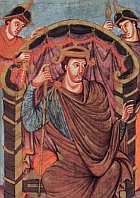 Carolingian civilization is recognized as the foundation of Middle Age Europe although the artistic advances of this period were initiated by Martel's grandson Charlemagne, who was crowned Holy Roman Emperor in 800.
Image at right : Carolingian era manuscript detail, c. 850, picturing Lothair I, Holy Roman Emperor, flanked by the evangelists.
The Carolingian empire itself did not survive past the ninth century, although, the forces set in motion during this era would inspire cultural expression and growth well through the Medieval age. Rare extant Carolingian architecture remains; the Palatine Chapel in Aachen and the West end of the Imperial Abbey of Corvey being perhaps the finest examples.
Decorated : The second of the three distinctive architectural styles of England's cathedrals, the first being Early English, the later, Perpendicular. A generalized date for the Decorated era is the middle thirteenth to the middle fourteenth centuries. It is within this period that the more distinctive features of English Gothic emerge, leaving behind evident transitional links with the Romanesque. Westminster Abbey is an example of construction during this era. Early English : The beginnings of Gothic in England span from the final years of the twelfth century through the first half of the thirteenth. Cathedrals primarily constructed within this period are Canterbury, Wells, Lincoln and Salisbury. Within each of these, excepting perhaps Salisbury, it is plain to recognize preceding Romanesque forms and elements.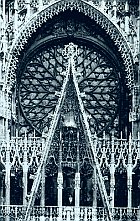 Flamboyant : The closing period of French Gothic during the late fourteenth and early fifteenth centuries. A style characterized by tracery designs which resemble upward spiraling flames, dominant in the north of France. A classic example of this work is the north spire of Chartres which stands in evident contrast to the remainder of the cathedral, completed two centuries before.
Image at right : Exterior of Rose window at Rouen cathedral, France; an ideal example of the Flamboyant style.
Gothic Art : Seldom separated from the building craft of the Cathedrals, the term is used loosely to refer to religious European art forms of the 12th through 16th centuries. Other mediums utilized extensively during this period, and within similar manner, were Painting, Tapestry, Metalwork, Glasswork and Manuscript Illumination. Mannerism : A prevalent style of art during the later half of the sixteenth century, characterized by a self-aware perspective with dominant, often disturbing, themes or moods. With roots in earlier artistic schools, Mannerist painters often projected themselves as opposition to the idealistic artists of the High Renaissance. Ottonian : A German art form which preceded the Romanesque, and followed the Carolingian, in which can be seen some early beginnings of forms and innovations what would later be fundamental to Gothic structures. A primary feature of some Ottonian churches was the use of systematic pier and column support within the Nave. Painterly : A style distinctly different from Linear, emphasizing shape and color over line. Made popular by artists such as Titian, Painterly works are found in several of the later Gothic cathedrals. Perpendicular : A distinctive English style within Gothic Architecture, contemporary to the French Flamboyant during the fourteenth and fifteenth centuries, yet having little else in common. The Perpendicular is clearly influenced by traditional Classicism in manners which are often impressively noble. While there is no cathedral constructed entirely within this style, a close candidate is Gloucester, built in the mid fourteenth century. The Nave at Canterbury was also executed during this time, and its clean, elegant lines are gracefully powerful. Rayonnant : The Radiant style, originating during the reign of Louis the Fourteenth in France, sometimes referred to as the Court style or 'the style of the French.' The name which carried through the ages refers to the patterning of the windows which allowed for such radiant lighting. The Renaissance : Occurring after the close of the Gothic age, the Renaissance should be factored into any serious study of these cathedrals. Much of the spiritual expression silenced at the end of the Gothic building period found new voice within Renaissance art forms, although their expression was fundamentally distinct from the Gothic style, which was perceived as crude and barbaric. Rococo : A style originating in France, but utilized primarily in English and Italian cathedrals of the early 1700s, as well as in renovations of the period. Distinctively lighter in expression with an emphasis on smaller, more graceful motifs.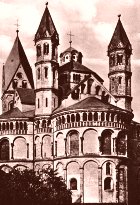 Romanesque : The architectural style immediately preceding the Gothic, first singular influence to spread across Europe in the Medieval age. Clearly identified by broad walls and pillars, the style derives its name from inspirations of Roman architecture.
Image at right : Exterior of St. Aposteln church, Cologne, Germany; one of twelve surviving Romanesque churches pre-dating the city's Gothic cathedral.
Many cathedrals and churches consist of a blending of Gothic/Romanesque elements; Canterbury, within its 11th century Crypt.
Romanticism : An artistic style which dominated or influenced much of European art through most of the nineteenth century. With an emphasis on emotional expression, the movement embraced the art of the Gothic period. Eventually responsible for the great Neo-Gothic building period of the later years of the century.“It is the business of a student of art and not of other men to write a history "from the monuments"; but in face of the problems connected with these half ruined or wholly destroyed buildings there must be sought the help of the reader of inscriptions, the decipherer of hieroglyphs and arrow-head characters, the student of comparative chronology, the practised and judicious reader of the books left us from antiquity, the curious searcher among vestiges of by-gone beliefs and superstitions.
 The artist cannot form his critical judgment of the ancient artist's work until by the aid of all those scholars, and by means of his own choice among the divergent and contradictory opinions which they offer, he has created in his own mind an image of what the lost building or the ruined building was really like. The practised builder is quicker than another to judge aright how the ancients builded, and the decorative designer who is familiar with the decoration of many lands and times is more to be trusted than another in his judgment of the artistic purpose of old Greek or older Egyptian; but as builder and decorator alike, the artist needs the help of the scholar, in puzzling out the significance of what has been left us by earthquake and flood, and the more destructive hands of ignorant men.”
“It is commonly supposed, and architects themselves in older days believed it, that an architect's business was to be an expert in style. Why he should be so was never explained. Modern practitioners have kept up a 'battle of the styles' without any such basis for their logic, or rather their eloquence. But what is or was a style? It is a museum name for a phase of past art. As a means of classifying what is dead and done the style labels are quite useful. It has, however, to be kept in mind that these styles, while they lived and moved, were processes which began, continued, and passed into something else. They were only phases like those of the changing moon. That which now professes to be designed in a style has not the essence of life. It is, therefore, not actually of the style which it simulates but is only in the 'style' of the style.
Indeed, the essence of all the old arts was in their vitality, their response to the natural conditions and the psychology of their times. The better we seem to reproduce their dead images the more we are unlike their soul-selves. There is little more reason for an architect to pretend to work in a style than there is for a chemist.”
—William R. Lethaby,Form In Civilization, 1922
“The complaint of the French artist against the Norman is the "mesquin" treatment of dividing his tower into storeys of equal height. Even in the twelfth century and in religious architecture, artists already struggled over the best solution of this particularly American problem of the twentieth century, and when tourists return to New York, they may look at the twenty-storey towers which decorate the city, to see whether the Norman or the French plan has won; but this, at least, will be sure in advance:—the Norman will be the practical scheme which states the facts, and stops; while the French will be the graceful one, which states the beauties, and more or less fits the facts to suit them. Both styles are great: both can sometimes be tiresome.”
—Henry Adams,Mont-Saint-Michel and Chartres, 1904

“In spite of several fine palaces of the Early Renaissance—and one really excellent example of what the usually vulgar, exaggerated, and theatrical Rococo style could achieve in the hands of a capable and delicate minded Italian architect of the seventeenth century, Santa Maria di Provenzano—Siena is essentially a Gothic city. Her position on the hilltops settled that, if it be true that the level lines and broad masses of Classic buildings require the widely spreading plain or open seashore for their fitting development. But the Pointed Style in Italy has little in common with mediæval buildings in France or England, and the student must be prepared to look for quite other beauties than those he is accustomed to trace in northern Cathedrals.”
—Gilbert Hastings,Siena, its Architecture and Art, 1902
Bibliography
 The Principles of Gothic Ecclesiastical Architecture,
Matthew Holbeche Bloxam, London, D. Bogue (1846)
Dictionnaire raisonné de l'architecture française du XIe au XVIe siècle,Eugène Viollet-le-Duc, Paris (1858-68)
Mont Saint-Michel and Chartres, Henry Adams, New York (1904) Gothic Painting, J. Dupont & C. Gnudi, Skira, Geneva (1954) The Gothic Cathedral, Otto von Simson, Pantheon, NY (1956) The Gothic, Paul Frankl , Princeton Univ. Press (1960) The Cathedral Builders, Jean Gimpel, Grove Press, NY (1961) Gothic Architecture, Robert Branner, G. Braziller, NY (1961) High Gothic, Hans Jantzen, Pantheon, NY (1962) History of Medieval Art I, II, III, Georges Duby, Skira, Geneva (1966-67) The Medieval Architect, J. H. Harvey, Pantheon, London (1972) The Age of the Cathedrals, Art and Society 980-1420, Georges Duby, London (1981) French Gothic Architecture of the 12th
and 13th Centuries,
J. Bony, Berkeley (1983) The Gothic Cathedral, Christopher Wilson, Thames & Hudson (1990) The Art of Gothic, Könemann Verlagsgesellschaft mbH, (1999)Development & Production Credits
Primary Text : Rhey Cedron — Theme Editor : Nicole MarchStructural Design & Project Direction : Rhey Cedron
Art Direction : Thierry Alberto — Art Production : Mark Nelson & Ash' Murti
Principal Photography : Rhey Cedron
Art Research : Malcolm Hurrell — Support Research : Walter McCrae
(Life) Support Production : Henry Craig, Joan Flandrin, Clara Kelly and
a Patient Legion of Friends, Family & Angels
cultural projects. Ask to receive your free newsletter

Your questions or comments are always welcome!
Gothic Dreams E-mail
Individual use of enclosed material is encouraged for the purposes of education and enjoyment.
The republication of textual or graphic content, without license, is an infringement of Copyright laws.
